How to Help Your Child Learn Italian When You’ve Just Moved to Italy
The boxes are half unpacked, the fridge is nearly empty, and your child is looking at you with one big question: “How will I talk to anyone here?”
If that is your family right now, take a breath. I am a British mum living in Italy, and I have watched children go from shy whispers to cheerful “Ciao!” faster than any grown-up expects. Children are wonderful language learners. What they need most from us is not perfect grammar. It is a little routine, a lot of encouragement, and the feeling that it is safe to have a go.
Here are the things that make the biggest difference in those first weeks.
Start with the words that open doors
Forget long verb tables for now. The first goal is helping your child feel at home, and that starts with a handful of everyday phrases:
- Ciao and Buongiorno (hello, good morning)
- Come ti chiami? (What’s your name?)
- Posso giocare? (Can I play?)
- Non ho capito (I didn’t understand)
- Posso andare in bagno? (Can I go to the toilet?)
- Grazie and Per favore (thank you, please)
“Non ho capito” is the hidden superstar. A child who can say “I didn’t understand” never has to sit silent and lost. Practise it at home until it feels as natural as “thank you”.
Little and often beats long and tiring
Ten minutes a day works better than an hour on Saturday. Young brains love repetition, and short sessions stop learning from turning into a chore. Try linking Italian to something you already do: three new words over breakfast, a quick game in the car, a phrase of the day stuck on the fridge.
Bring Italian into everyday life
Italy itself is your classroom. Let your child order the gelato. Count the oranges together at the market. Read the signs on the way to the park. Every small success (“I said it and they understood me!”) builds the confidence that makes the next conversation easier.
Italian cartoons, picture books from the local library and children’s songs are brilliant too. Your child doesn’t need to understand every word. Hearing the music of the language is part of learning it.
Keep the home language strong
This one surprises many parents: please don’t stop speaking your own language at home. A child’s first language is the foundation they build Italian on. Words and ideas they already know in their home language are much easier to carry across into Italian. It is also part of who they are, and it keeps them close to family back home.
So speak, read and sing in your home language, and add Italian alongside it. Two languages are a gift, not a competition.
Be patient with the quiet phase
Many children go through a quiet spell when they arrive somewhere new. They listen far more than they speak, soaking everything up. It can be worrying, but it is a normal part of learning. Keep talking to them, keep reading together, and celebrate every word when it comes. Often the words arrive in a sudden rush.
Learn together
Children love it when Mum or Dad is learning too, especially when the grown-up gets it wrong. Laugh at your mistakes, ask your child to teach you a word they picked up today, and show them that trying matters more than being perfect. You will need Italian too, for chats with teachers, forms and the doctor’s surgery, so you might as well learn as a team.
Where Scuola Italia fits in
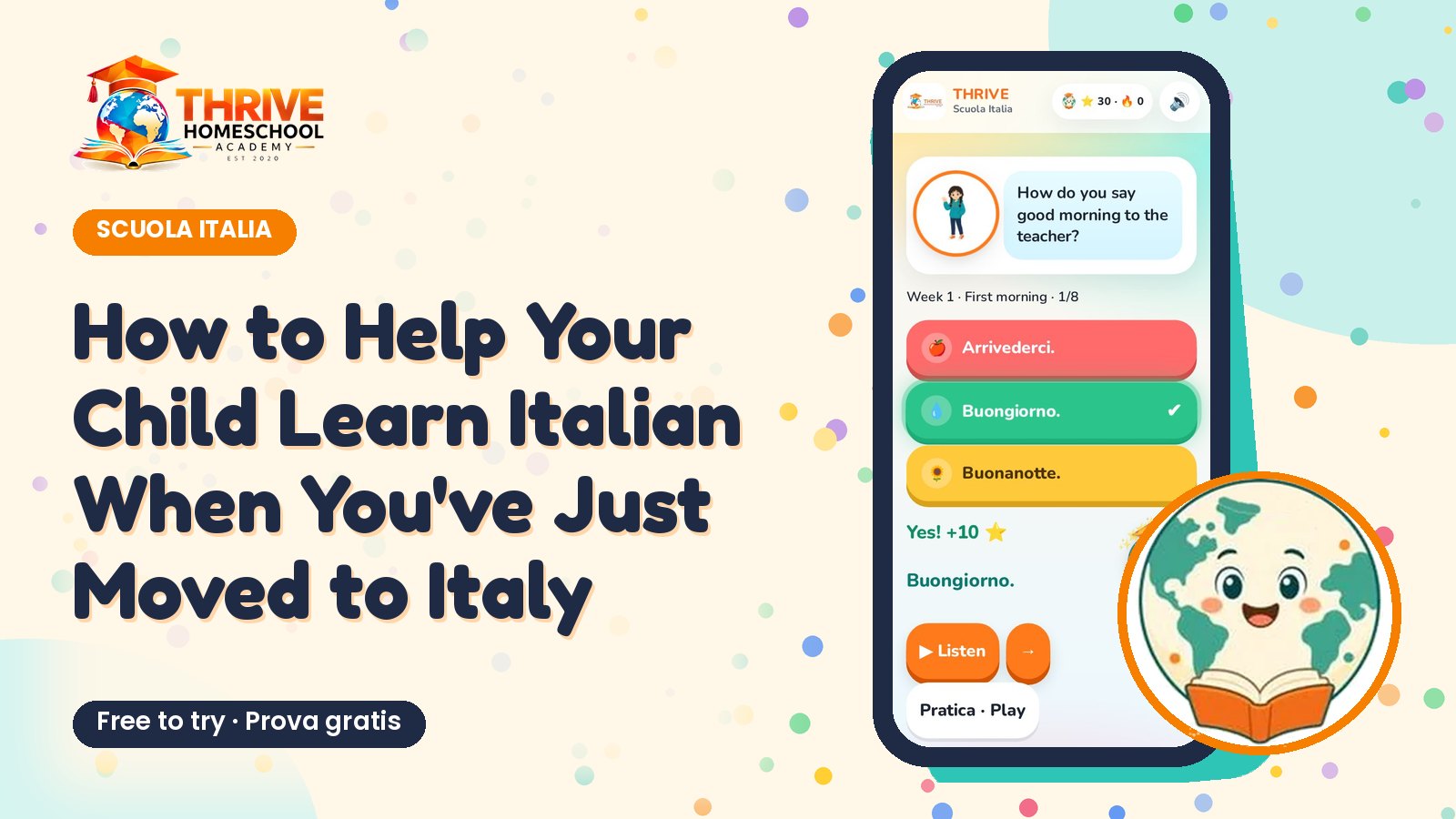
I created Thrive Scuola Italia because I wanted a gentle, playful way for children aged 3 to 15 to learn Italian from the language they already speak. You choose your home language from 10 options, and every Italian word is spoken aloud. The lessons follow real-life moments: the classroom, the playground, school subjects and talking with teachers. There are flip cards for little ones, a daily challenge, and Globo, a friendly mascot who cheers your child on.
It works for every child new to Italy, whether they are starting at an Italian school or learning at home through istruzione parentale (homeschooling in Italy). Parents can learn right alongside their children, too.
You’ve got this
Moving country is a big adventure for a little person. With short daily practice, lots of praise and a home where both languages are welcome, your child will find their feet, and their words, sooner than you think.
Try Thrive Scuola Italia free: scuolaitalia.app
Find more family learning ideas at Thrive Homeschool Academy: Visit the Thrive website
A presto!
Ann